-
Mistletoe Jam Remembered

If you missed the Mistletoe jam this year, you missed a great one. Here are some of the highlights:
Dead batteries, blown tires, and AAA.
Hammered and mountain dulcimers jamming happily together.
Introduction to the Dulcimer lessons taught in the bathroom (giving a whole new meaning to potty training).
Rain, rain, and rain.
A live parrot that squawked – but, sadly, not in the key of D.
Surprise appearances by old friends, and new members who signed up on the spot.
Fireplaces that set off the smoke detectors in at least 2 cabins.
Warm welcomes, tasty snacks and that famous tricky-spout coffee pot.
Whooping lessons by Betty.
Three dogs snoozing peacefully at our feet on a rainy night (giving a whole new meaning to – well, you get it I’m sure).
Playing tunes and then trying to remember the name of the tune we just played.
Everyone’s favorite bass accompanist: the lovely and talented Ms. Ernestine Tubb.
Jams accessorized with fiddles, concertinas and pennywhistles.
Swapping YouTube recommendations, including “Pants on the Ground” and “I Just Don’t Look Good Naked Anymore.”
All music, all the time – from Friday afternoon to Sunday afternoon.
Goodbye-hugs, and lots of kudos to our wonderful hosts, the Garden City Strummers (in the hopes they’ll invite us back next year!)
-
TAKING CARE OF THINGS

At one corner of our house I have a rain barrel that proved really useful during the recent drought here in Georgia; it provided water to plants that wouldn’t have survived otherwise. I forgot to take care of it before the recent bitter cold, but when I remembered the barrel, I assumed that it would be all right. It had survived other cold weather quite well, and so it was amazing to lift the filter off the top and find a solid cake of ice surrounded by very little water. The block seemed to fill up the entire barrel. I felt lucky that the barrel hadn’t burst and the faucet at the bottom hadn’t been ruined. I need to take care of things I value.
Even though NGFDA isn’t a rain barrel and its members certainly are not plants -- not even Mr. Lincoln roses -- it does need care and attention. A lot of us value it. At the Fall Festival Peggy Martin organized a breakfast for leaders of the satellites to attend; most satellites had representatives there, and they talked about issues of concern and ways to solve them. The board of directors will hear from Peggy at our winter board meeting about those ideas, and we will work on those. The board also asked that members fill out a questionnaire about what they want from the association. Not a huge number responded, perhaps fifteen to twenty percent, but those that did offered a range of ideas and opinions. Some ideas came from people who had attended the satellite breakfast, and the board is already planning to carry out one suggestion. I will summarize the comments at the winter board meeting, and we will work on those.
A few respondents to the survey said that we need to encourage more young players. They said they looked around and saw few younger players and concluded we are a graying, aging organization. What’s the old joke? I resemble that remark! At the age of 69, I do, indeed. To the point, I think NGFDA recognizes that issue and is working with satellites to encourage recruitment of new members through providing lessons at the satellite level for new players and through making sure that satellites don’t turn into just performance groups that shun new players. Not that we do not need to value long-time members or performance groups. The longer I act as your president, the more I appreciate the commitment, talent, and work of such people and such groups.
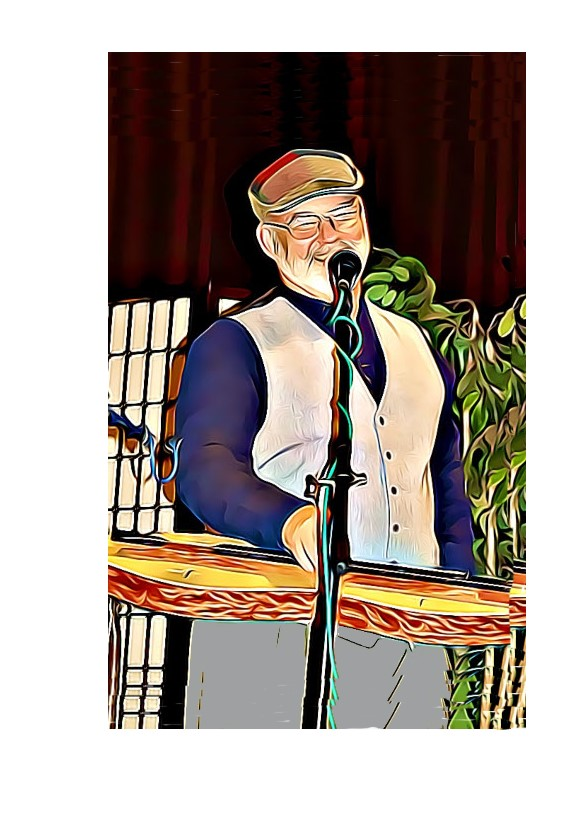
That said, NGFDA can and must encourage young players. From them will come a Butch Ross and a Steve Seifert carrying on the old traditions with a twist or a Bing Futch pushing the boundaries of what the dulcimer can do. I watched a really young player (was he eight, nine, ten, eleven?) with admiration at the Mistletoe Jam last weekend. He led us in a blistering rendition of “Mississippi Sawyer,” and the crowd roared its approval after he finished. His whole body seemed in sync with the rhythms he played as he bobbed and wove naturally. He will probably thrive anyhow, yet we need to take care to feed the talent and enthusiasm of such young players.
We have a chance to do so. Friends of a long-time member in Florida wanted to remember him after his death with contributions to a scholarship fund. And so the board revived a long dormant scholarship fund. We received a number of contributions. We have also recently received a sizable donation from Mike Van Demark’s wife. We now are challenged with using these donations wisely to fund scholarships to the Fall Festival.
We face a problem, though. The reason the scholarship fund lay dormant so long was that no one could figure out how to award scholarships based on need. Here I’ll be very blunt: I don’t want to ask for information from families of potential scholarship recipients and try to figure out a way to evaluate, protect, and secure private financial information. I don’t have that capability, and I don’t think other board members do either. Unless someone knows of a business that can handle that process for a very reasonable fee, I prefer to use the money we have collected to award scholarships based on merit. With the help of others much more knowledgeable than I am, I can figure out how to devise scoring sheets or rubrics to evaluate tapes submitted by young players to determine merit. I can design rubrics to evaluate essays from very new players about why they want to attend the Fall Festival and what they want to learn. And we have enough in the scholarship fund to award at least a couple of scholarships that will pay for attendance at the Fall Festival -- room and board for a player and chaperone for a night plus registration. We could avoid the issue of need altogether.
It is not up to me to decide what to do. The board will decide. Whatever we do, I hope we will continue to take care of satellites, the jams they sponsor, the Fall Festival, the Spring Thing, the balance of our bank account, the newsletter and websites, and equally important, the encouragement of young players. Rain barrels need taking care of. More importantly, NGFDA and its future need taking care of.
-
Want A Quick NEW Way To Get Your Newsletter?
- 1. Go to www.ngfda.org.
- 2. Click the newsletter tab
- 3. Enter your email address of record with the club
That’s all there is to it – you can print it out or read it online. If you’ve been getting a paper copy in the mail and decide to switch, please email gwillix@bellsouth.net and we’ll discontinue the mailed copy.
You’ll be saving the club the growing expense of printing and postage, and you’ll be easing the burden on our two stalwart volunteers who pick up almost 400 printed copies, apply postage and address labels, and mail them every month!
-
A Dulcimoron I Am, I Am
-
-
-
-
-
I lent someone my bass dulcimer to use while members from the LaGrange Troupers played carols at a church luncheon. When I brought along a stand for the bass, the woman said, “I guess that means you have all your dulcimer equipment here now.”
-
“No,” I admitted, “I have six dulcimers and several more stands.”
-
“Whatever for?” the always practical lady asked.
-
“They’re all different. There’s the Galax tuned one, and the baritone. I, I, I just like dulcimers,” I said lamely, as if she had caught me eating too many peanuts from the lead crystal dish set out for company.
-
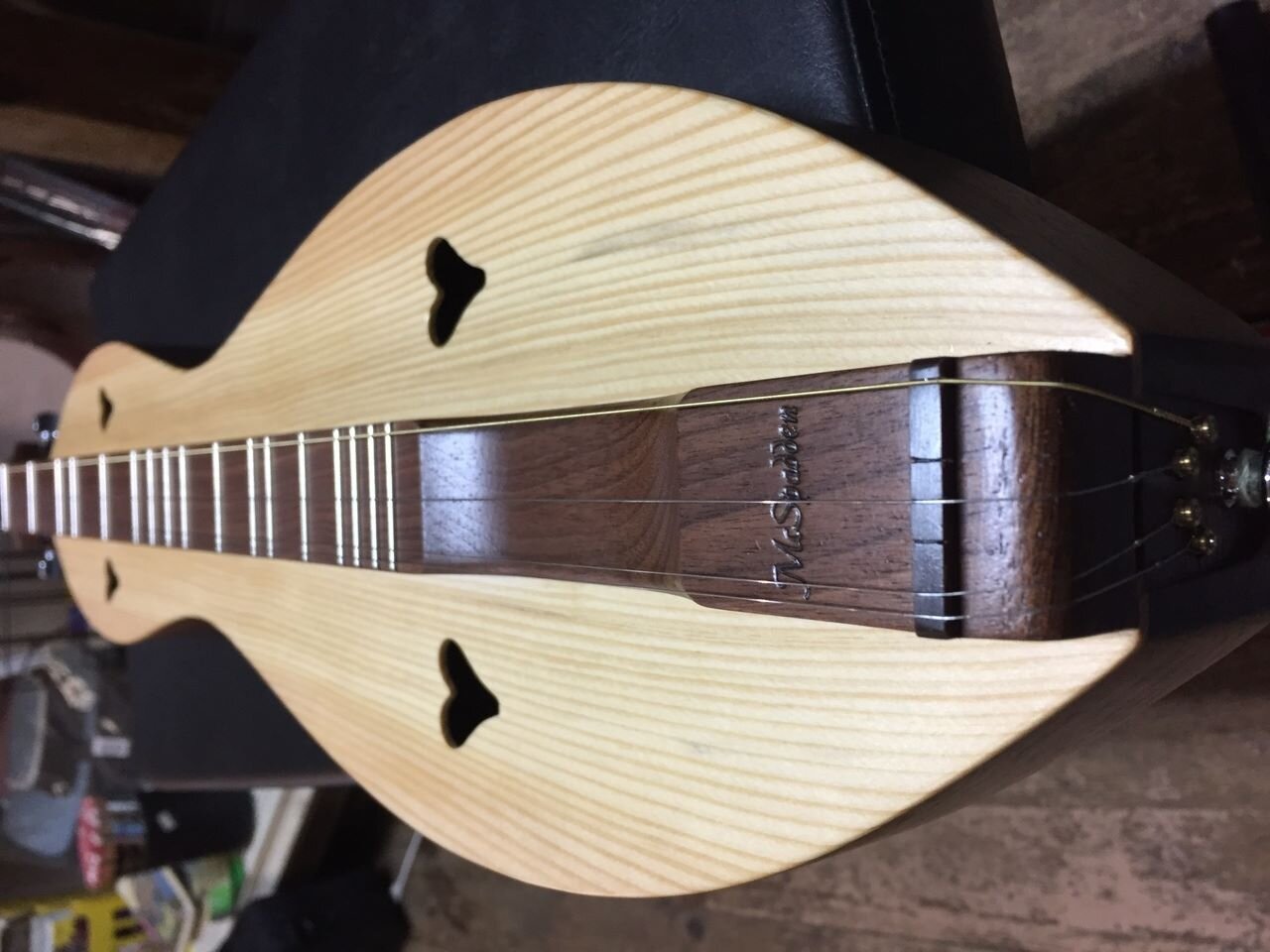
And there is a problem, one perhaps best identified with a term that the Arkansas writer Donald Harington used in one of his quirky, imaginative, and funny novels I have enjoyed reading. Many of his novels involve the Arkansas town of Stay More and its inhabitants, whom he labels Staymorons. In The Pitcher Shower, his novel about a traveling outdoor movie theatre owner set in the 1930’s in the Ozarks area around Stay More, Harington was describing a string band and wrote there was a dulcimoron in the group. I laughed out loud. I don’t know exactly what Harington had in mind when he used the term, but I know what it brings to mind about me. I have bought more dulcimers than I know what to do with or really how to play well. That includes the baritone dulcimer, something I’ve played around with but have never gotten really serious about learning to play well.
-
So to learn to play better the baritone dulcimer, I called the home of Pam and Terry Lewis this week in their snowy world of Virginia, where they had relied on a generator to provide power this past weekend. Pam answered, and she immediately began answering the question, “What’s a baritone dulcimer good for?”
-
“Well, just about anything. It’s a beautiful solo instrument with a wonderful tone for playing melody. For our Christmas concert, I played all the melodies of the carols on the baritone.”
-
“Really?” I thought that confirmed the idea that the baritone dulcimer really can sound beautiful. With my dulcimer, that means strumming across the strum hollow.
-
‘But I use it mainly for backup,” she added. “Anything that a standard dulcimer can be used for in backup, a baritone can be used for: Chords. Countermelodies. Harmonies. All of those parts can be adapted for the baritone. If I tune my baritone to Adaa, I can play any of those parts while the other dulcimers play in Dadd. If the chords or countermelodies or harmonies are simple, I don’t even have to write them out. I just figure them out my head.”
-
“Yeah,” I agreed, “Only it makes my head hurt after a while to do that to harmonize the other strings with the middle string.”
-
“You get used to it,” she said, “but if a part is complicated, I will use TablEdit to adapt it. The other thing is, now that I have learned the chords in Adaa, if the group I’m playing with wants to switch from the key of D to the key of A, I don’t even have to retune. I know the chords to play in the key of A. And if I want to play the melody, what I do now is play across all the strings to the third fret. That gives me an octave.”
-
Pam had gained a head of steam talking about the baritone, pouring out ideas almost faster than I could keep up. “The right hand techniques are a little different. I don’t play so many eighth notes. Instead I play quarter notes and hold them longer. Playing eighth notes makes the baritone sound muddy. So instead of ‘bum diddly,’ I just play quarter notes. The backup or countermelody or whatever is there, just not as rhythmically. You get the same effect, though.”
-
“There’s that resonance of the baritone that sounds wonderful,” I remarked, “It’s something you get only a little of if you play on the bass string of a standard dulcimer.”
-
Pam agreed.
-
“If I’m playing solo, I can tune the baritone to Aeaa and play the standard tab written for a standard dulcimer. I don’t have to change a thing, because it’s in a 1-5-8 tuning.”
-
Pam said, “Terry’s the expert. You really need to talk to him, and he’s not here right now.” I agreed to call back later. And I did. But the phone was busy for hours on end. Terry will have to wait. Pam gave me enough to go on, and if I need to get some baritone tab, I can always go to Terry Lewis’ website. He has a few songs tabbed for the baritone dulcimer there.
-
A dulcimoron I am. But I’m working on the baritone to learn to play it well. That’s one less dulcimer to feel foolish about because I don’t know what to do with it.